
Universal Pipette Tips
Disposable pipette tips designed to fit single and multichannel pipettes from most manufacturers; offer acceptable performance compared to pipette specific tips and can be used with a variety of pipette models.
Single-use universal pipette tips are designed for compatibility with most mechanical and electronic single and multichannel pipettors.
Universal pipette tips are available in a range of types, sizes, colors, styles, and packaging configurations and may be designed for specific purposes or tasks.
- Capacity or volume based on the pipettor size
- Filters to reduce contamination and cross-contamination
- Color
- Sterility or autoclavability
- Tip style: beveled, tapered, wide bore, round, flat, or gel-loading
- Length: short or extended
- Purity: metal-free or DNase-, RNase-, ATP-, Bioburden-, PCR inhibitor-, endotoxin-, or pyrogen-free for genomic and biologic applications
- Surface treatments to reduce retention
- Packaging options to help facilitate re-stocking or eliminate waste


ABclonal Technology ADIPOR1 Rabbit pAb

This gene encodes a protein which acts as a receptor for adiponectin, a hormone secreted by adipocytes which regulates fatty acid catabolism and glucose levels. Binding of adiponectin to the encoded protein results in activation of an AMP-activated kinase signaling pathway which affects levels of fatty acid oxidation and insulin sensitivity. A pseudogene of this gene is located on chromosome 14. Multiple alternatively spliced transcript variants have been found for this gene.


ABclonal Technology KCNS2 Rabbit pAb
Predicted to enable voltage-gated potassium channel activity. Predicted to be involved in potassium ion transmembrane transport and regulation of delayed rectifier potassium channel activity. Predicted to be located in perinuclear region of cytoplasm and plasma membrane. Predicted to be part of voltage-gated potassium channel complex. Predicted to be integral component of membrane.

ABclonal Technology PRR5 Rabbit pAb
This gene encodes a protein with a proline-rich domain. This gene is located in a region of chromosome 22 reported to contain a tumor suppressor gene that may be involved in breast and colorectal tumorigenesis. The protein is a component of the mammalian target of rapamycin complex 2 (mTORC2), and it regulates platelet-derived growth factor (PDGF) receptor beta expression and PDGF signaling to Akt and S6K1. Alternative splicing and the use of alternative promoters results in transcripts encoding different isoforms. Read-through transcripts from this gene into the downstream Rho GTPase activating protein 8 (ARHGAP8) gene also exist, which led to the original description of PRR5 and ARHGAP8 being a single gene.

ABclonal Technology FBXL12 Rabbit pAb
Members of the F-box protein family, such as FBXL12, are characterized by an approximately 40-amino acid F-box motif. SCF complexes, formed by SKP1 (MIM 601434), cullin (see CUL1, MIM 603134), and F-box proteins, act as protein-ubiquitin ligases. F-box proteins interact with SKP1 through the F box, and they interact with ubiquitination targets through other protein interaction domains (Jin et al., 2004 [PubMed 15520277]).
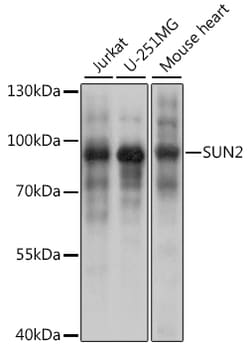
ABclonal Technology SUN2 Rabbit pAb
SUN1 (MIM 607723) and SUN2 are inner nuclear membrane (INM) proteins that play a major role in nuclear-cytoplasmic connection by formation of a bridge across the nuclear envelope, known as the LINC complex, via interaction with the conserved luminal KASH domain of nesprins (e.g., SYNE1, MIM 608441) located in the outer nuclear membrane (ONM). The LINC complex provides a direct connection between the nuclear lamina and the cytoskeleton, which contributes to nuclear positioning and cellular rigidity (summary by Haque et al., 2010 [PubMed 19933576]).
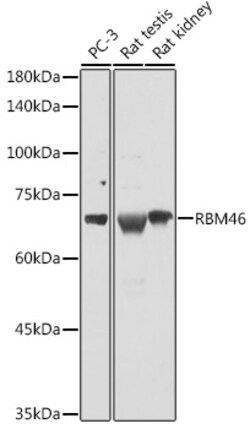
ABclonal Technology RBM46 Rabbit pAb
Predicted to enable mRNA binding activity. Predicted to act upstream of or within mRNA stabilization and trophectodermal cell differentiation. Predicted to be active in nucleus.

ABclonal Technology EDC4 Rabbit pAb
Predicted to be involved in deadenylation-independent decapping of nuclear-transcribed mRNA. Located in P-body and nucleoplasm.

ABclonal Technology DICER1 Rabbit pAb
This gene encodes a protein possessing an RNA helicase motif containing a DEXH box in its amino terminus and an RNA motif in the carboxy terminus. The encoded protein functions as a ribonuclease and is required by the RNA interference and small temporal RNA (stRNA) pathways to produce the active small RNA component that represses gene expression. This protein also acts as a strong antiviral agent with activity against RNA viruses, including the Zika and SARS-CoV-2 viruses. Alternative splicing results in multiple transcript variants.

ABclonal Technology SGPL1 Rabbit pAb
Enables sphinganine-1-phosphate aldolase activity. Involved in apoptotic signaling pathway, fatty acid metabolic process, and sphingolipid metabolic process. Located in endoplasmic reticulum. Implicated in nephrotic syndrome type 14.

ABclonal Technology PLS1 Rabbit pAb
Plastins are a family of actin-binding proteins that are conserved throughout eukaryote evolution and expressed in most tissues of higher eukaryotes. In humans, two ubiquitous plastin isoforms (L and T) have been identified. The protein encoded by this gene is a third distinct plastin isoform, which is specifically expressed at high levels in the small intestine. Alternatively spliced transcript variants varying in the 5 UTR, but encoding the same protein, have been found for this gene. A pseudogene of this gene is found on chromosome 11.

ABclonal Technology GSTT2B Rabbit pAb
The protein encoded by this gene, glutathione S-transferase (GST) theta 2B (GSTT2B), is a member of a superfamily of proteins that catalyze the conjugation of reduced glutathione to a variety of electrophilic and hydrophobic compounds. Human GSTs can be divided into five main classes alpha, mu, pi, theta, and zeta. The theta class includes GSTT1, GSTT2, and GSTT2B. GSTT2 and GSTT2B are nearly identical to each other, and share 55% amino acid identity with GSTT1. All three genes may play a role in human carcinogenesis. The GSTT2B gene is a pseudogene in some populations.

ABclonal Technology H3Q5ser Rabbit pAb
Histones are basic nuclear proteins that are responsible for the nucleosome structure of the chromosomal fiber in eukaryotes. This structure consists of approximately 146 bp of DNA wrapped around a nucleosome, an octamer composed of pairs of each of the four core histones (H2A, H2B, H3, and H4). The chromatin fiber is further compacted through the interaction of a linker histone, H1, with the DNA between the nucleosomes to form higher order chromatin structures. This gene is intronless and encodes a replication-dependent histone that is a member of the histone H3 family. Transcripts from this gene lack polyA tails, instead, they contain a palindromic termination element. This gene is found in the large histone gene cluster on chromosome 6p22-p21.3.

ABclonal Technology HSCB Rabbit pAb
This gene encodes a DnaJ-type co-chaperone and member of the heat shock cognate B (HscB) family of proteins. The encoded protein plays a role in the synthesis of iron-sulfur clusters, protein cofactors that are involved in the redox reactions of mitochondrial electron transport and other processes. Cells in which this gene is knocked down exhibit reduced activity of iron-sulfur cluster-dependent enzymes including succinate dehydrogenase and aconitase. The encoded protein may stimulate the ATPase activity of the mitochondrial stress-70 protein. Alternative splicing results in multiple transcript variants.
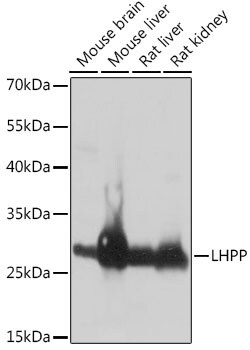
ABclonal Technology LHPP Rabbit pAb
Enables inorganic diphosphatase activity and protein homodimerization activity. Involved in phosphate-containing compound metabolic process. Located in cytosol and nuclear speck.
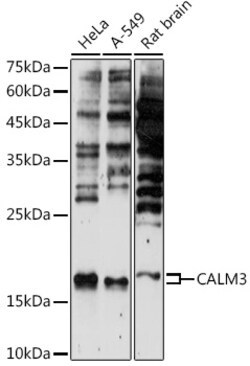
ABclonal Technology CALM3 Rabbit pAb
This gene encodes a member of a family of proteins that binds calcium and functions as a enzymatic co-factor. Activity of this protein is important in the regulation of the cell cycle and cytokinesis. Multiple alternatively spliced transcript variants have been observed at this gene.